Calculating ROI on Consumer Market Research
The "Cost of Ignorance" represents the most dangerous variable on your modern balance sheet. Failed product launches and deep cultural misalignments aren't just PR headaches; they are massive capital drains.
Jembe.Intelligence
September 21, 2026

In 2026, the most expensive research you'll ever buy is the data that arrives three weeks too late to matter. Traditional, static models have become a line-item liability in a world that moves at the speed of culture. If your board still views insights as an overhead cost rather than a high-velocity growth engine, the problem isn't the budget; it's the math. Mastering the art of calculating ROI on consumer market research is no longer just about justifying spend. It's about proving how real-time cultural intelligence accelerates market share and mitigates the risk of diverse audience engagement.
You know that deep human insights are the heartbeat of strategy, yet quantifying "soft" cultural shifts for the C-suite remains a persistent hurdle. This guide provides the precise formulas and strategic metrics required to transform your research department into a profit center. We'll break down the 2026 Strategic Framework, showing you how to link automated sentiment analysis to bottom-line growth while building a bulletproof case for continuous investment.
Key Takeaways
- Stop treating research as a static expense and learn to position your insights as a high-velocity strategic operating system powered by Jembe.intelligence.
- Master the precise math of calculating ROI on consumer market research by linking incremental sales and cost avoidance to specific strategic deployments.
- Accelerate your go-to-market velocity through automated sentiment analysis that cuts through the noise of shifting cultural landscapes in real-time.
- Transition from episodic project spikes to a continuous intelligence model that uses managed qualitative data to validate quantitative trends before you commit your budget.
The Strategic Framework for Consumer Research ROI
Stop viewing market research as a static line-item expense. In a high-velocity economy, ROI is the measurable delta between stagnant data and strategic velocity. It encompasses direct revenue growth, aggressive cost avoidance, and the accelerated speed at which your organization pivots. When you're calculating ROI on consumer market research, you're essentially auditing the efficiency of your strategic operating system. Research isn't a cost center; it is a high-velocity strategic operating system that drives every major decision. It's the difference between driving blind and navigating with high-definition, real-time radar.
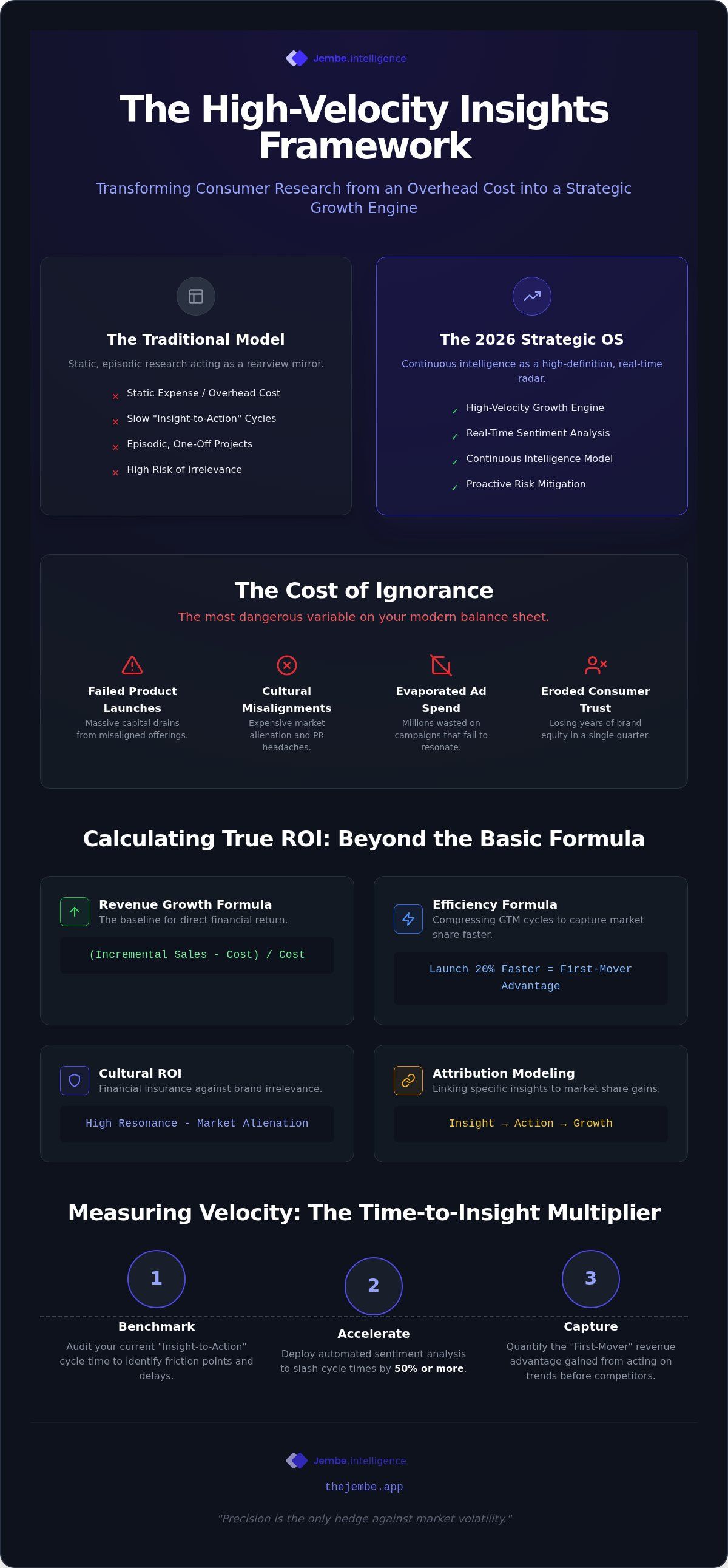
The "Cost of Ignorance" represents the most dangerous variable on your modern balance sheet. Failed product launches and deep cultural misalignments aren't just PR headaches; they are massive capital drains. A single misaligned campaign can evaporate millions in marketing spend while eroding years of accumulated consumer trust. By calculating ROI on consumer market research through the lens of risk mitigation, you protect your most valuable asset: brand reputation. We've moved past the era where gut feeling is a viable strategy for global players. Precision is the only hedge against market volatility.
Quantifying Cultural Risk and Brand Equity
Brands that ignore cultural nuance face a direct financial liability. When organizations fail to grasp the complexities of modern identity, they risk expensive market alienation that can take decades to repair. Understanding what is cultural intelligence allows it to function as a sophisticated financial insurance policy for your brand relevance. It transforms vague sentiment into actionable data, ensuring every dollar spent on engagement drives resonance rather than rejection. Cultural ROI is the delta between high-resonance engagement and expensive market alienation.
How to Calculate ROI: Beyond the Basic Formula
Traditional ROI is a post-mortem. When you're calculating ROI on consumer market research, you need a forward-looking windshield, not a rearview mirror. The Revenue Growth Formula (Incremental Sales minus Cost of Research) divided by Cost of Research serves as your baseline. However, it's incomplete without the Efficiency Formula. This measures the compression of your Go-to-Market (GTM) cycles. If you launch 20% faster, you're not just saving hours; you're capturing market share before the competition even wakes up. Precision beats participation every time.
Attribution modeling is the bridge between data and dominance. It links specific, research-backed decisions to market share gains in diverse segments. By isolating the impact of a cultural pivot or a targeted product tweak, you prove that calculating ROI on consumer market research is about identifying the engine of growth. This level of granularity gives the C-suite the confidence to double down on high-resonance strategies. It transforms "gut feeling" into a measurable, repeatable growth lever.
Measuring Velocity: The Time-to-Insight Multiplier
Velocity is the ultimate competitive advantage in 2026. You can turn research into a predictive power tool by following a streamlined audit of your current operations:
- Benchmark: Audit your current "Insight-to-Action" cycle time to identify where legacy thinking and slow data collection create friction.
- Accelerate: Deploy automated sentiment analysis to slash cycle times by 50% or more, turning months of delay into days of action.
- Capture: Calculate the "First-Mover" revenue advantage by quantifying the capital gained from identifying shifts before they hit the mainstream.
By accelerating your intelligence, you ensure your brand stays ahead of shifting social landscapes. Consider how you can integrate high-velocity insights into your existing workflow to maintain this momentum.
Implementing a High-Velocity Insights Strategy
Episodic research is a relic of a slower era. If your strategy relies on one-off projects, you're essentially gambling on snapshots of a moving target. The 2026 framework demands a shift toward a Continuous Intelligence model. By integrating managed qualitative research, you validate quantitative trends with the human-centered "why" data that numerical sets often ignore. This integration is critical when calculating ROI on consumer market research, as it transforms raw data into a living strategic asset that fuels constant momentum.
The ultimate goal is radical relevance. In an environment where consumer identity is increasingly fluid, deep-audience personas allow you to navigate complex social landscapes with surgical precision. This level of insight ensures your brand remains a living, breathing system rather than a static fixture. When you focus on these metrics, calculating ROI on consumer market research becomes a simple exercise in measuring market dominance and the elimination of strategic friction. It's about ensuring your brand isn't just present, but indispensable.
Scaling Radical Relevance with Jembe.intelligence
Strategic evolution requires a system that bridges the gap between raw cultural data and executive action. Through custom cultural persona development, you can dramatically reduce waste in marketing spend by ensuring every campaign resonates with cultural precision. The compounding ROI of a Jembe.intelligence subscription lies in its ability to function as your strategic operating system, accelerating the path from discovery to dominance. It's time to move beyond traditional, slow-moving thinking. Accelerate your strategic evolution with Jembe.intelligence and turn insights into an unstoppable growth engine.
Mastering the Velocity of Cultural Intelligence
The era of static data has ended. Precision and speed are now the only metrics that define market leadership. By calculating ROI on consumer market research through the lens of strategic velocity, you transform deep insights into a high-octane growth engine. You've mastered the formulas to quantify the cost of ignorance and learned to leverage automated sentiment analysis to slash go-to-market cycles. Now, you must bridge the gap between raw data and executive dominance.
Whether you require managed qualitative studies for human-centered depth or a visionary strategic partnership to navigate diverse audience segments, the tools for evolution are ready. Real-time reporting and cultural fluency aren't just competitive advantages; they're requirements for survival. Stop measuring the past and start engineering your future.
Accelerate your Strategic Evolution with Jembe.intelligence
Frequently Asked Questions
Is market research ROI always measured in direct revenue?
Direct revenue is the ultimate goal, but it isn't the only metric that matters. You must also quantify cost avoidance and strategic acceleration. A successful framework accounts for the "Cost of Ignorance," which measures the financial fallout from cultural missteps or failed product launches. High-velocity insights protect your brand equity, acting as a sophisticated insurance policy against market volatility.
How do I calculate the ROI of qualitative research specifically?
You calculate qualitative ROI by measuring the reduction in strategic friction and the increase in resonance. Managed qualitative research studies provide the deep human-centered data that quantitative metrics miss. By validating the "why" behind consumer behavior, you prevent expensive market alienation. The ROI is the delta between a campaign that flops due to tone-deafness and one that achieves radical relevance.
What is a 'good' ROI for consumer market research in 2026?
A benchmark for calculating ROI on consumer market research in 2026 is its ability to accelerate go-to-market cycles by 50% or more. A "good" return isn't just a static percentage; it's the competitive advantage gained through first-mover revenue. If your research doesn't drive immediate momentum or mitigate cultural risk, it's a liability. True ROI is found in the velocity of your cultural fluency.
Can automated sentiment analysis replace traditional ROI reporting?
Automated sentiment analysis is a high-velocity multiplier, not a total replacement for traditional reporting. It provides the real-time reporting necessary to pivot strategies before a budget is wasted. While it offers a predictive pulse on shifting social landscapes, traditional financial validation remains essential for C-suite buy-in. Together, they form a living strategic operating system that ensures your brand stays ahead of the curve.
Want this kind of intelligence wired into your team's workflow? Get started with Jembe.Intelligence →