Quantitative Syndicated Research: Engineering Category Dominance in 2026
Foundational concepts in Quantitative marketing research teach us that scale provides validity. Without category-wide benchmarks, your brand health metrics exist in a vacuum. You might see growth, but if the category is outpacing you, you're actually losing ground.
Jembe.Intelligence
June 06, 2026

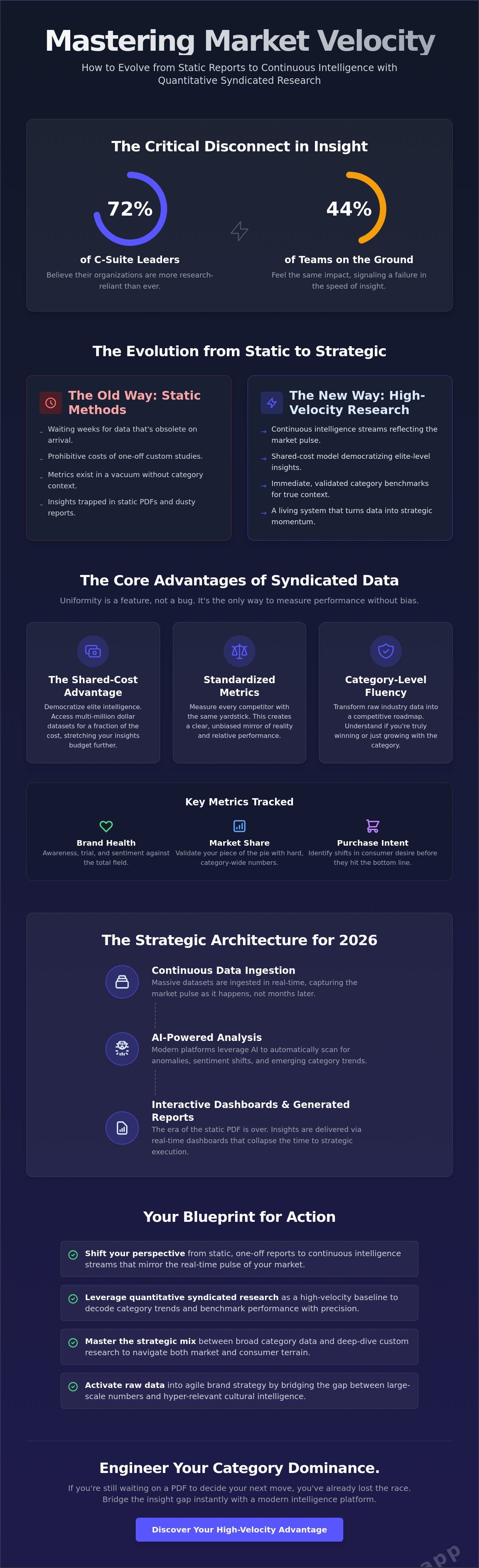
72% of C-suite leaders believe their organizations are more research-reliant than ever, yet only 44% of the teams on the ground feel the same impact. This disconnect signals a critical failure in the speed of insight. You've likely felt the frustration of waiting weeks for data only to find it's obsolete by the time it arrives. Static methods can't keep pace with a world that moves at the speed of an algorithm. To lead, you need high-velocity quantitative syndicated research that acts as a living system, providing immediate, validated category benchmarks without the prohibitive costs of custom studies.
It's time to evolve. This guide shows you how to master the mechanics of syndicated data to decode market trends and outpace the competition with precision. We'll explore how to leverage automated streams and AI-native tools to transform raw numbers into strategic momentum. You'll learn how to secure a foundation for deeper qualitative exploration while scaling your insights with unprecedented efficiency. Let's engineer your category dominance for 2026.
Key Takeaways
- Shift your perspective from static, one-off reports to continuous intelligence streams that mirror the real-time pulse of your market.
- Leverage quantitative syndicated research as a high-velocity baseline to decode category trends and benchmark your performance with absolute precision.
- Master the strategic mix between broad category landscape data and deep-dive custom research to navigate both the market and the consumer terrain.
- Discover how to activate raw data into agile brand strategy by bridging the gap between large-scale numbers and hyper-relevant cultural intelligence.
- Integrate automated sentiment analysis to add depth to your quantitative findings, ensuring your strategy is as fluid as the modern consumer identity.
Beyond the Basics: Defining Quantitative Syndicated Research for 2026
Precision is the only currency that matters in a high-velocity market. Traditional, static data collection is too slow to capture the shifting tectonic plates of consumer behavior. Quantitative syndicated research provides a shared-cost methodology where a third-party firm independently collects large-scale, standardized data across an entire industry. It's the baseline for category survival. By 2026, the industry has moved beyond the dusty "one-off report" toward continuous intelligence streams that offer a real-time pulse of the market. You don't just need data; you need a living system that benchmarks your position against the total category with surgical accuracy.
Just as researchers in technical industries rely on Electron Optics Instruments, LLC for the high-precision tools required to analyze microscopic details, market leaders use syndicated research as a lens to identify the subtle shifts that define their competitive landscape.
Foundational concepts in Quantitative marketing research teach us that scale provides validity. Without category-wide benchmarks, your brand health metrics exist in a vacuum. You might see growth, but if the category is outpacing you, you're actually losing ground. Quantitative syndicated research is a strategic asset for category-level fluency that transforms raw industry data into a competitive roadmap.
The Shared-Cost Advantage: Scaling Your Insights Budget
Syndicated models democratize elite intelligence. They allow brands to access multi-million dollar datasets, often covering thousands of respondents, for a fraction of the cost of a proprietary study. The trade-off is simple: you accept a standardized methodology in exchange for massive scale and competitive context. It's about efficiency. You stop paying for the infrastructure of data collection and start investing in the activation of the results. It allows your budget to stretch further, covering broad market trends while leaving room for tactical, deep-dive initiatives.
Standardized Metrics: The Language of Category Dominance
Uniformity is a feature, not a bug. When every competitor is measured using the same yardstick, the data becomes a clear mirror of reality. It's the only way to measure relative performance without the bias of custom-built internal surveys. Key metrics typically include:
- Brand Health: Tracking awareness, trial, and sentiment against the total field.
- Market Share: Validating your piece of the pie with hard, category-wide numbers.
- Purchase Intent: Identifying shifts in consumer desire before they hit the bottom line.
The Strategic Architecture of Modern Syndicated Data
In the 2026 market, speed isn't a luxury; it's the baseline. Static reports gathered months ago are irrelevant. Modern quantitative syndicated research functions as a high-velocity pulse, capturing shifts in consumer sentiment as they happen. It's about moving beyond the lag of quarterly updates to a continuous flow of intelligence. To stay ahead, brands must adopt best practices for syndicated research that prioritize real-time data ingestion and automated sentiment analysis. This enrichment turns flat numbers into a living map of human desire.
Modern platforms are the architects of this transformation. They ingest massive datasets to provide streamlined analysis and reporting, ensuring that insights are available the moment they're needed. If you're still waiting on a PDF to decide your next move, you've already lost the race. Exploring modern intelligence platforms can bridge this gap instantly.
From Raw Data to Generated Reports
The era of the static PDF is over. Modern deliverables have evolved into interactive dashboards and generated reports that refresh in real-time. These systems leverage AI to scan for anomalies and emerging category trends automatically. They flag a sudden dip in brand sentiment or a spike in competitor purchase intent before a human analyst even opens the file. This automation collapses the time between data collection and strategic execution.
As AI becomes central to interpreting complex market data, educational platforms like IAB Academy are providing the necessary training in financial literacy and AI-driven analysis to help leaders bridge the gap between raw information and actionable strategy.
Ensuring Sample Fluency in National Research
Panel integrity is the foundation of truth. In a fragmented consumer market, traditional demographic buckets like age or zip code are insufficient. You need sample fluency. This requires aggressive cross-cultural weighting to ensure national consumer panels actually reflect the modern identity. Without this precision, your quantitative syndicated research is just a collection of noise. Accuracy requires a commitment to representative samples that account for the nuances of a shifting social environment.
Orchestrating the Mix: Custom vs. Quantitative Syndicated Research
Strategy isn't binary. It's a symphony of scale and depth. To dominate your category in 2026, you must understand the distinction between the 'landscape' and the 'terrain'. Quantitative syndicated research maps the broad landscape, showing you where the mountains are and where the rivers flow across the entire industry. Custom research, conversely, allows you to navigate the specific terrain of your unique business challenges. While syndicated data provides the 'what' of market movements, custom research uncovers the 'why' behind specific consumer choices.
Choosing between them requires a cold-eyed cost-benefit analysis. You don't need to reinvent the wheel for every data point. Refer to our detailed guide on Custom vs. Syndicated Research Pricing for ROI modeling that fits your growth stage. Stop buying custom reports for baseline metrics that quantitative syndicated research already delivers with greater efficiency. It's about allocating your resources where they generate the most friction-free momentum.
When Syndicated Research is the Superior Choice
Speed is the primary driver. When you have an immediate need for category entry or competitive benchmarking, waiting for a custom study is a tactical error. Syndicated models allow you to track long-term industry shifts without the massive overhead of custom survey design. It's about establishing a baseline of truth quickly. Use it to validate your market share or monitor brand health relative to the field. It provides the high-velocity intelligence needed to pivot before the competition even sees the curve.
The Hybrid Approach: Building a 360-Degree Insights Stack
Agile brands don't choose; they integrate. The most effective strategy uses category trend analysis to identify friction points that trigger deep-dive custom qualitative work. This hybrid stack ensures your high-level quantitative findings are grounded in the reality of custom cultural personas. It's a living intelligence system that scales with your ambition. Ready to build your stack? Explore the Jembe Platform subscription to start engineering your dominance today.
Activating Insights: Turning Syndicated Data into Brand Momentum
Data is static. Intelligence is agile. In the high-stakes environment of 2026, simply possessing information isn't a competitive advantage. The real power lies in the activation of that data. To bridge the gap between large-scale quantitative results and hyper-relevant brand strategy, you must infuse raw numbers with human context. Quantitative syndicated research offers the necessary scale, but it requires a strategic lens to transform those benchmarks into brand momentum. You've mapped the landscape; now you must move through it.
Moving from observation to execution is the most critical phase of the research lifecycle. It's where the theoretical becomes tactical. When you deploy quantitative syndicated research, you aren't just looking for facts. You're looking for leverage. This leverage is found at the intersection of category-wide scale and specific cultural nuance. By integrating your quantitative findings with cross-cultural consumer behavior insights, you ensure your strategy resonates across diverse audience segments. You don't just see the market. You understand the forces driving it.
Managed Research: The Jembe Advantage
Raw datasets can be overwhelming. Our managed qualitative and quantitative services take the heavy lifting out of analyzing complex syndicated streams. We don't just hand over a dashboard; we customize the interpretation of shared data to fit your specific brand narrative. It's about finding the signal in the noise. We help you navigate the nuances of your category, ensuring every insight is a direct catalyst for growth. We turn standardized data into proprietary power. As you leverage these insights, protecting your organization's digital footprint is equally essential; you can learn more about deleteme to safeguard your corporate and personal information from unwanted exposure.
For companies seeking to translate this growth into investor interest, you can discover Pre-IPO Hype to learn how to prepare for a Reg A+ capital raise in 2026.
Next Steps: Accelerate Your Strategic Evolution
The window for dominance is shrinking. To stay ahead, you must move with intention. Start by auditing your current research stack for gaps in category-wide visibility. Identify one key category trend that requires immediate quantitative validation to secure your 2026 roadmap. It's time to stop observing and start leading. Evolution is mandatory. Execution is everything.
- Audit your internal data streams for lag and obsolescence.
- Benchmark your brand health against the total category to find hidden friction points.
- Validate emerging trends with high-velocity data before they become mainstream.
Scale your intelligence with The Jembe’s managed research services.
Forge Your Future: The Path to Category Fluency
The distance between data collection and strategic execution is collapsing. To lead in 2026, you can't rely on the slow-moving metrics of the past. You need a living system that tracks the pulse of the market in real-time. By mastering quantitative syndicated research, you've established the category-wide benchmarks necessary to identify your brand's true position. You've learned that while syndicated data provides the landscape, your ability to activate that data with cultural nuance defines your dominance. It's about moving from static observation to high-velocity impact.
Success requires more than just access; it requires the right partner to turn raw numbers into strategic momentum. We provide the specialized cultural intelligence framework and real-time automated sentiment analysis you need to stay ahead of the curve. Don't let your insights become obsolete before they hit your desk. It's time to embrace a more agile, technologically-driven approach to understanding your environment. Accelerate your category dominance with The Jembe through our managed end-to-end research services. The future of your category is waiting. Go claim it.
Frequently Asked Questions
What is the primary difference between syndicated and custom research?
The primary difference lies in ownership and strategic scope. Syndicated research is a shared-cost model where a research firm independently collects standardized data and sells it to multiple clients to provide a category-wide baseline. Custom research is proprietary and designed for your brand's specific questions. While quantitative syndicated research gives you the landscape of market movements, custom research uncovers the terrain of your unique business challenges.
How much does quantitative syndicated research typically cost?
Pricing for quantitative syndicated research depends on the depth of the industry category and the scale of the consumer panel involved. Because the investment is shared among multiple subscribers, it's significantly more cost-efficient than commissioning a proprietary study of the same scale. This model allows brands to access massive, high-velocity datasets that would otherwise be budget-prohibitive as a standalone project.
Can I influence the methodology of a syndicated research study?
Standardization is a core feature of syndicated models, so individual clients typically don't influence the methodology. This uniformity is what makes the data valuable; it ensures every competitor is measured against the same yardstick for accurate benchmarking. If you need a specific methodology or unique questions, the most effective approach is to supplement your syndicated baseline with managed qualitative or custom quantitative studies.
Is syndicated data reliable for niche or emerging markets?
Syndicated data is highly reliable for established categories, but its value in niche markets depends on the provider's panel integrity. Modern platforms now use advanced weighting and cross-cultural fluency to ensure representative samples even in fragmented landscapes. For emerging markets, it's essential to choose a provider that emphasizes high-velocity data collection to capture shifts before they become mainstream trends.
How often is syndicated research data updated in 2026?
By 2026, the industry has moved beyond static quarterly updates toward continuous intelligence streams. Many modern systems provide real-time pulses or weekly refreshes through interactive dashboards rather than traditional PDF reports. This constant flow of data ensures that your strategy is always based on the living pulse of the market rather than obsolete historical snapshots.
Want this kind of intelligence wired into your team's workflow? Get started with Jembe.Intelligence →