Category Trend Analysis: Decoding the Cultural Pulse of 2026
Trends exist in a hierarchy of impact. Macro-trends provide the tectonic shifts that redefine entire industries, while micro-shifts are the fast-moving ripples that offer immediate tactical opportunities.
Jembe.Intelligence
May 31, 2026
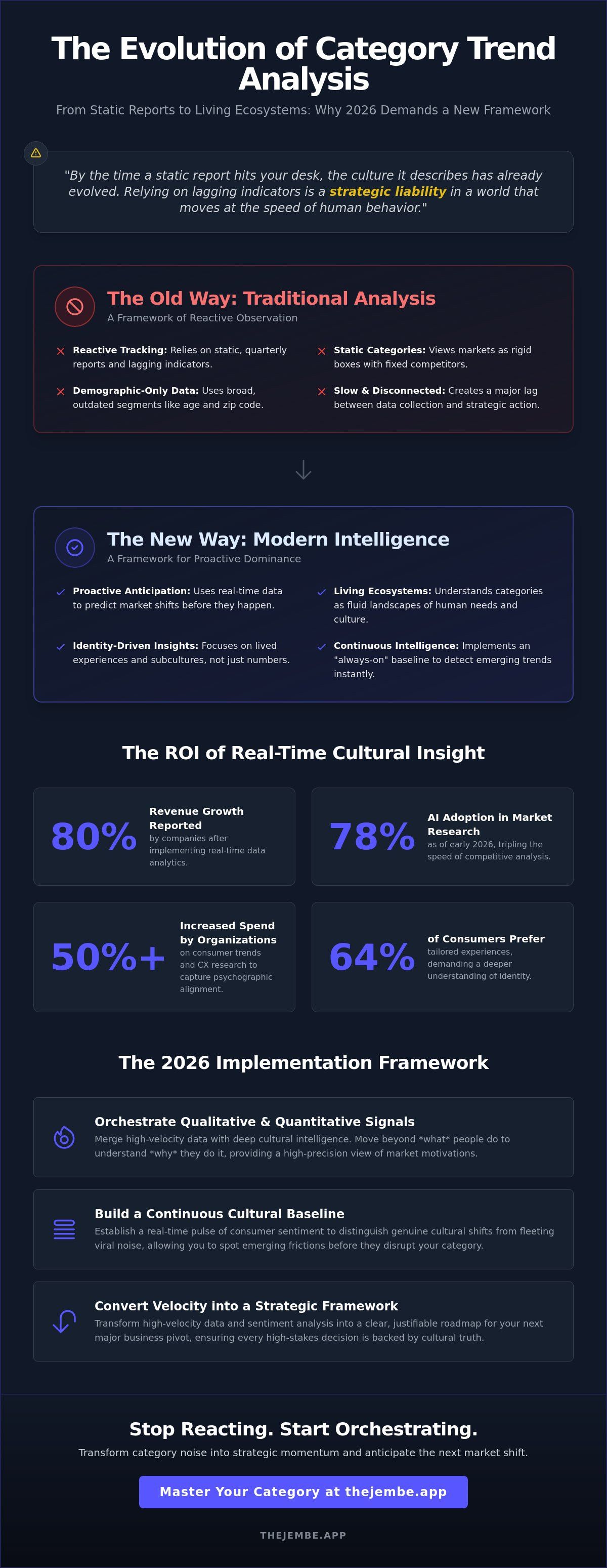
By the time a static report hits your desk, the culture it describes has already evolved. What if your data didn't just record the past, but predicted the pulse of tomorrow? Relying on lagging indicators is a liability in a world where 80% of companies report revenue growth specifically from real-time analytics. You need a category trend analysis framework that moves at the speed of human behavior. Not the speed of a quarterly review. It's time to stop reacting to the noise. It's time to start orchestrating the signal.
You've felt the disconnect between broad category data and the sharp, specific nuances of real-world culture. This article bridges that gap. You'll learn to master the art of category trend analysis by merging high-velocity data with deep cultural intelligence to anticipate market shifts before they happen. We'll break down the 2026 landscape, showing you how to align with shifting consumer identities and build a rigorous framework to justify your highest-stakes strategic pivots. We're moving beyond observation into the realm of active category dominance.
Key Takeaways
- Redefine your market as a living ecosystem to shift from reactive tracking to proactive trend anticipation.
- Ditch demographic-only data in favor of identity-driven insights that capture the true pulse of fragmented consumer groups.
- Learn how to orchestrate managed qualitative research and quantitative scale for a high-precision category trend analysis.
- Build a continuous cultural baseline to identify emerging frictions before they disrupt your market position.
- Convert high-velocity sentiment data into a clear strategic framework that justifies your next major business pivot.
Decoding the Velocity: What is Category Trend Analysis in 2026?
Categories aren't static boxes. They're living ecosystems. In 2026, category trend analysis isn't about tracking what happened six months ago; it's about decoding the cultural signals that dictate what happens next. The market has moved beyond the slow, reactive cycles of the past decade. We've entered an era of high-velocity research where the pulse of the consumer changes in days, not years. You need to stop viewing your category as a list of competitors and start seeing it as a fluid landscape of human needs and technological acceleration. Speed is the new currency. Proactive anticipation is the only way to stay solvent.
The Anatomy of a Modern Category Trend
Trends exist in a hierarchy of impact. Macro-trends provide the tectonic shifts that redefine entire industries, while micro-shifts are the fast-moving ripples that offer immediate tactical opportunities. Understanding the lifecycle from cultural fringe to category standard is essential for timing your strategic moves. While foundational statistical trend analysis helps identify historical patterns, the modern strategist must look deeper. You have to distinguish the "signal" of a genuine cultural shift from the "noise" of a passing viral moment. This is where automated sentiment analysis becomes critical. It allows you to establish a real-time baseline of consumer emotion, filtering out the distractions to find the frictions that actually drive market evolution.
Why Traditional Static Reporting is a Strategic Liability
Static reports are the obituaries of trends. If you're relying on quarterly decks, you're already behind. The lag time between data collection and executive action has become a primary strategic liability. Modern consumers are intersectional. They don't fit into the rigid demographic buckets that legacy research once relied on. Their identities are fragmented and fluid. It's no surprise that 80% of companies report an increase in revenue after implementing real-time data analytics. This shift reflects a fundamental reality: the market rewards the agile. With AI adoption in market research hitting 78% as of early 2026, the speed of competition has tripled. Continuous intelligence is no longer a luxury for the few. It's the baseline requirement for maintaining brand relevance in a world that refuses to stand still.
The Cultural Engine: Why Traditional Category Analysis is Obsolete
Traditional methods are failing. They treat consumers like spreadsheets. But people aren't numbers; they're ecosystems of identity. Search data might show what they buy, but it misses the cultural why. Effective category trend analysis must now account for these invisible layers of human interaction. We've moved past the era where a product's features define its market share. Today, a category is defined by the lived experiences of the people who inhabit it. If you aren't decoding the cultural engine driving these shifts, you're just documenting your own decline.
Demographics vs. Lived Experiences
Age and zip code no longer predict behavior with any meaningful accuracy. A 30 year old in a tech hub and a 30 year old in a rural community may share a demographic profile, but their cultural allegiances are worlds apart. This fragmentation is why over 50% of organizations are aggressively increasing their spend in consumer trends and CX research as of late 2025. They've realized that psychographic alignment is the true driver of category growth. The "New American Consumer" isn't a monolith. They are a collection of hyper-specific identities that demand brands understand their specific social context. When you stop looking at the census and start looking at subcultures, you find the real opportunities for dominance. This is why sophisticated brands are moving toward Custom Cultural Persona Development to replace outdated, generic customer profiles.
The Velocity of Cultural Identity
Digital communities act as accelerators for market disruption. A niche social movement can rewrite category rules in a weekend. This speed requires a new kind of fluency. Brands have to speak the language of their audience in real-time or risk being viewed as intruders. Cultural Intelligence is the ability to interpret and adapt to shifting social landscapes. It's the difference between a brand that feels like a legacy institution and one that feels like a living, breathing participant in the culture. While 64% of consumers prefer tailored experiences, 51% remain wary of how their data is used. Navigating this tension requires more than just raw data; it requires the strategic clarity to know which signals matter. You don't need more noise. You need the intelligence to act on the right frequency before the window of opportunity slams shut.
Core Methodologies: Orchestrating Qualitative and Quantitative Signals
Data is a compass, not the destination. To master category trend analysis, you must move beyond the technical modeling of raw numbers. True market foresight lives at the intersection of high-velocity quantitative scale and deep qualitative nuance. It's an orchestration. While legacy systems treat these as separate silos, the modern strategist integrates them to create a living, breathing view of the consumer. You need the "what" to set the course and the "why" to drive the momentum. This methodology transforms overwhelming noise into a proactive strategy for category dominance.
Quantitative Syndicated Research: The Strategic Foundation
Broad market context begins with a solid foundation. Leveraging quantitative syndicated research allows you to establish the "what" and "how much" across your entire category. It's about benchmarking your performance against competitors in real-time. This isn't just about data collection; it's about clarity. High-quality generated reports ensure that every department, from product to marketing, is aligned on the same market realities. When 78% of companies are already using AI for data analysis as of early 2026, your competitive edge comes from how quickly you can turn these broad signals into a unified strategic baseline. Automated sentiment analysis then captures the real-time pulse of the brand, providing an immediate feedback loop that static models lack.
Managed Qualitative Research: Unlocking the "Why"
Numbers tell you that a shift is happening. Qualitative research tells you why it's happening. Through managed qualitative research studies, you can capture the lived experiences of your audience. Modern diary studies and video analysis reveal the unmet needs that raw data simply cannot detect. This is where Custom Cultural Persona Development becomes essential. It humanizes the noise. By turning raw human interaction into actionable reporting and strategic roadmaps, you move from observing a trend to owning it. This dual-engine approach ensures you aren't just reacting to the market. You're anticipating its next move. It bridges the gap between broad category data and the specific cultural nuances that dictate success or failure in a fragmented landscape.
Implementation Framework: Anticipating the Next Category Shift
Strategy without execution is just hallucination. You've identified the signals. Now you must operationalize them. Dominance isn't an accident; it's the result of a rigorous, high-velocity framework that turns raw data into market movement. If your category trend analysis stops at the report, you've already lost. You need a system that translates cultural data into immediate strategic action. This isn't about one-off studies. It's about building a living loop of intelligence that informs every decision you make. The goal is to move from observation to orchestration.
The process starts with a continuous cultural baseline. You can't spot a shift if you don't know where the ground is. Use a cultural intelligence platform to monitor the steady state of your audience. From there, deploy automated sentiment analysis to identify emerging frictions. These are the sparks of disruption. Once you find a signal, validate it with managed qualitative research to understand the human "why". Synthesize these findings into a custom cultural persona to guide your creative and product teams. Finally, execute with high-velocity reporting that allows for real-time iteration. This cycle ensures you stay ahead of the curve.
Identifying Emerging Frictions and Opportunities
Friction is your greatest opportunity. It represents the gap between what consumers expect and what the category currently offers. Disruption often comes from outside your industry, as seen in the 535% surge in G2 pricing software page views during 2025 and early 2026. This suggests that consumer expectations regarding transparency and value are shifting across the board. Conduct a momentum check: is your brand moving as fast as the subcultures you serve? If you aren't identifying these gaps in real-time, your competitors will. Spotting the "gap" requires looking beyond your immediate rivals to the broader social landscape.
From Analysis to Strategic Execution
Complexity kills momentum. To drive a high-stakes pivot, you must translate intricate cultural data into brief, punchy assertions that leadership can act on. We've seen that 80% of companies report revenue growth after adopting real-time analytics. This growth isn't just from the data; it's from the agility to implement it. Move from research to execution in weeks, not months. By orchestrating a mix of internal strategy and Managed Qualitative Research Studies, you ensure your brand remains alert, sharp, and ahead of the curve. It's about creating a culture of agility where data drives action, not just discussion.
The Jembe Edge: Transforming Category Noise into Strategic Momentum
Information is infinite. Clarity is rare. In the high-velocity environment of 2026, the traditional tools of category trend analysis are no longer enough to maintain a competitive edge. You need more than just a data provider; you need a visionary partner that understands the hidden layers of human interaction. The Jembe Platform Subscription is designed to be your high-tech guide through social complexity. We don't just deliver data. We deliver the strategic momentum required to dominate your category before the next shift even begins.
Our Automated Sentiment Analysis Reports provide instant brand clarity by filtering out the superficial noise of the digital landscape. While legacy systems get bogged down in volume, we prioritize precision. This clarity allows you to identify emerging frictions in real-time. By bridging the gap between cold business strategy and the fluid nature of modern consumer identity, The Jembe ensures your brand remains a living participant in the culture. It's about moving from a static position to a state of constant, intelligent evolution.
A Visionary Approach to Category Intelligence
Forward-looking brands require more than just surface-level insights. They demand radical relevance. The Jembe is the essential partner for those who refuse to settle for the status quo. Our Managed Qualitative Research Studies go beyond the "what" to uncover the "why" behind every market movement. By moving beyond basic demographics, we help you embrace the full spectrum of consumer lived experience. This rigorous research methodology ensures that your strategy isn't just informed; it's transformative. We turn raw human interaction into Custom Cultural Persona Development, providing a blueprint for authentic engagement in a fragmented world.
Accelerate Your Strategic Evolution
The Jembe isn't a mechanical tool. It's a living, breathing system for real-time market adaptation. We empower you to unleash human-centered data to navigate the social landscapes of 2026 with confidence. Whether you're leveraging our Quantitative syndicated research for broad context or our detailed analysis and reporting for specific pivots, the goal remains the same: category dominance. The pace of the world isn't going to slow down. Your ability to anticipate it must speed up. It's time to move beyond conventional, slow-moving thinking and embrace an agile, tech-driven approach to understanding your environment.
Orchestrate Your Future: Owning the Category Pulse
The era of reacting to market shifts is over. To lead in 2026, you must master a high-velocity category trend analysis that prioritizes cultural intelligence over static data. We've explored how identity-driven consumption and real-time sentiment analysis have replaced the slow-moving cycles of the past. By orchestrating managed qualitative research with automated quantitative scale, you can finally bridge the gap between business strategy and the lived experiences of your audience. The momentum of the modern world waits for no one. It's time to stop observing the change and start driving it.
Your strategic evolution requires tools that move at the speed of human behavior. With visionary cultural intelligence and real-time automated sentiment reporting, you can transform market noise into a definitive roadmap for dominance. Don't let your strategy be an obituary of a trend that's already passed. Accelerate your strategy with The Jembe Platform today. Embrace the power of managed qualitative research with expert analysis to secure your place at the cutting edge. The future is waiting for your next move.
Frequently Asked Questions
What is the primary difference between category trend analysis and product analysis?
Product analysis focuses on SKU-level performance and specific features, while category trend analysis examines the entire ecosystem of cultural signals and human needs. It's the difference between looking at a single tree and mapping the entire forest's soil and climate. Category analysis identifies the broader shifts that dictate which products will even be relevant in the next market cycle.
How often should an enterprise brand perform category trend analysis?
Enterprise brands must move toward a continuous, real-time baseline rather than relying on quarterly intervals. With 80% of companies reporting revenue growth from real-time analytics as of late 2025, waiting three months for a report is a strategic liability. High-velocity environments require weekly sentiment monitoring paired with monthly deep-dives into emerging cultural frictions to maintain a proactive stance.
Can automated sentiment analysis replace traditional qualitative research?
Automated sentiment analysis provides high-velocity scale, but it cannot replace the deep "why" found in managed qualitative research studies. It acts as a radar system to spot ripples across the social landscape. Once a signal is identified, qualitative studies are essential to decode the lived experiences and unmet needs that raw data simply cannot capture.
What are the most important KPIs to track in category trend analysis?
Focus on the velocity of sentiment shifts, cultural resonance scores, and the category friction index. Traditional metrics like market share are lagging indicators that only record the past. You need leading indicators that measure how quickly a subculture is adopting a new behavior or the level of tension between current offerings and consumer expectations.
How does cultural intelligence impact the accuracy of trend forecasting?
Cultural intelligence transforms raw data into a predictive engine by providing the context for why trends emerge. It's the filter that separates passing noise from genuine market shifts. Without it, forecasting is just mathematical extrapolation of the past, which fails when consumer identities fragment and social rules rewrite themselves in real-time.
Why is "lived experience" more valuable than "demographic data" in 2026?
Lived experience captures the fluid reality of how people navigate the world, whereas demographic data relies on static, outdated buckets like age or zip code. In 2026, identity is intersectional and digital. A consumer's cultural allegiance predicts their buying behavior more accurately than their census profile ever could, making lived experience the primary driver of category growth.
How can small strategy teams manage high-velocity category analysis?
Small teams must leverage automated platforms and managed research services to achieve enterprise-level scale without the overhead. By using automated sentiment analysis reports to monitor the baseline, a lean team can focus their limited bandwidth on high-stakes strategic pivots and qualitative validation of the most critical cultural signals.
What is the role of syndicated research in a modern category strategy?
Quantitative syndicated research provides the broad market context and competitive benchmarks necessary for a solid strategic foundation. It establishes the "what" and "how much" across the category. This allows you to justify your specific, high-touch qualitative investments by grounding them in verified market-wide realities and cross-departmental alignment.
Want this kind of intelligence wired into your team's workflow? Get started with Jembe.Intelligence →