Cross-Cultural Consumer Behavior: Decoding the Pulse of Global Markets in 2026
The old playbook is dead. In 2026, relying on age, race, or zip codes to predict market movement is a high-stakes gamble. These static data points capture a moment in time, but they fail to capture the pulse of human motivation.
Jembe.Intelligence
June 04, 2026

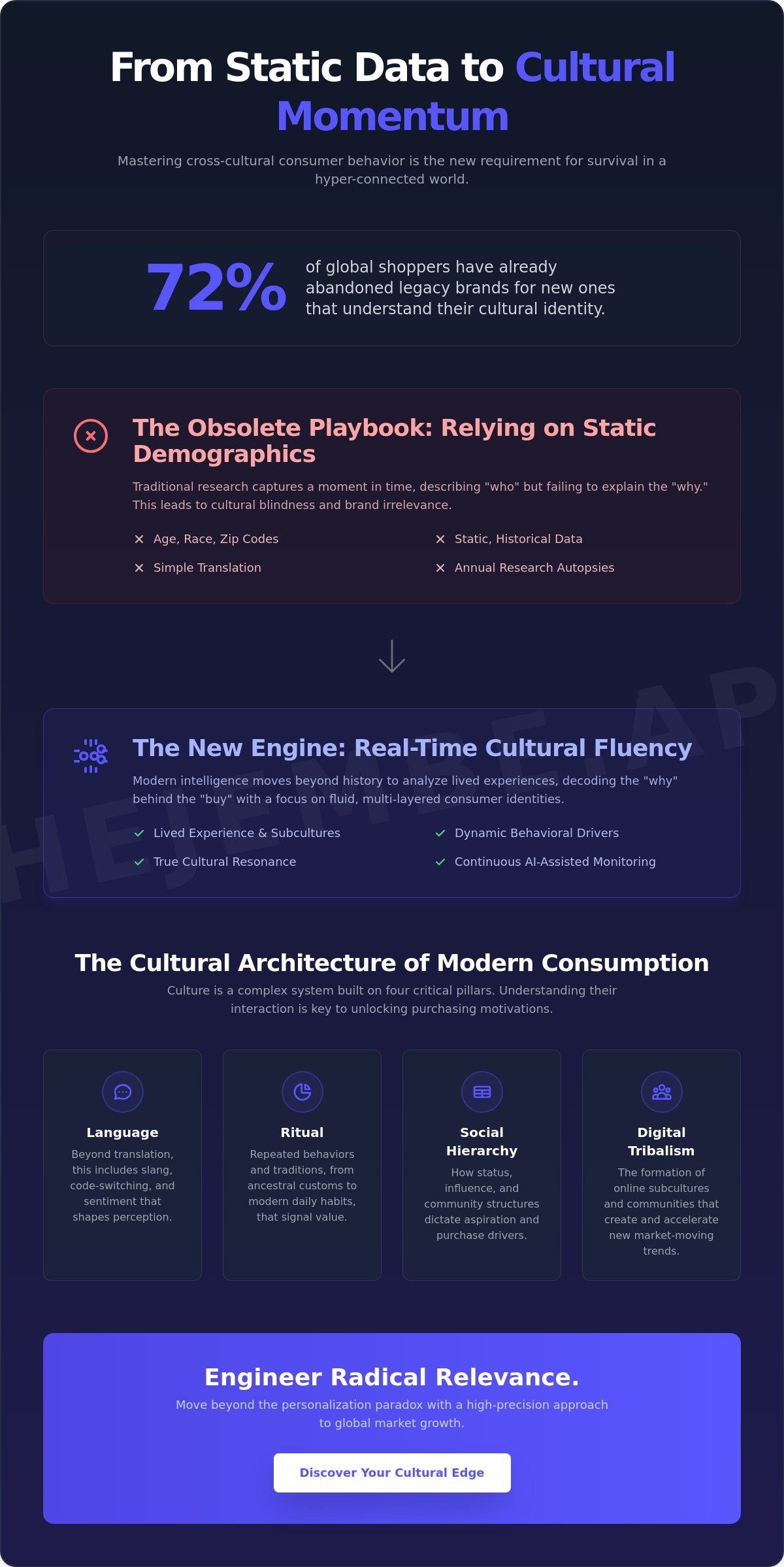
Seventy-two percent of global shoppers have already abandoned their legacy brands for a new name that actually speaks their language. In an era where social commerce is surging toward the $100 billion mark, relying on static demographic spreadsheets is a strategy for obsolescence. You've likely felt the frustration of holding data that describes "who" but never "why." The fear of cultural misalignment is real, and the pace of change is relentless. Mastering cross-cultural consumer behavior is no longer a luxury; it's a requirement for survival in a hyper-connected world.
This article promises to help you bridge the gap between cultural identity and buying habits to drive radical brand relevance. We'll provide a sophisticated framework for understanding modern consumer identity and the underlying drivers of global purchase intent. You'll gain actionable insights into the rise of the AI-assisted shopper and learn how to maintain real-time cultural fluency. It's time to move beyond the personalization paradox and embrace a high-precision approach to global market growth.
Key Takeaways
- Decode the "why" behind global buying habits by moving beyond static demographic data into the realm of deep behavioral drivers.
- Identify the pillars of modern consumption, including rituals and digital tribalism, to achieve genuine cultural fluency rather than simple translation.
- Implement a high-precision framework to audit brand perception and develop sophisticated Cultural Personas based on real-time human interaction.
- Discover how a cultural intelligence platform uses automated sentiment analysis to transform complex market data into actionable strategic signals.
- Master the nuances of cross-cultural consumer behavior to ensure your brand maintains radical relevance and momentum in an increasingly diverse marketplace.
Beyond the Surface: Redefining Cross-Cultural Consumer Behavior
The old playbook is dead. In 2026, relying on age, race, or zip codes to predict market movement is a high-stakes gamble. These static data points capture a moment in time, but they fail to capture the pulse of human motivation. We define cross-cultural consumer behavior as the rigorous study of how cultural identity dictates the "why" behind the "buy"—a motivation that leads eco-conscious families to choose sustainable brands like Mama Bamboo. It's the difference between seeing a customer and understanding a human.
This understanding of human motivation is essential when analyzing how consumers prioritize health and wellness across different regions; for those interested in natural consumption trends, you can find out more about how le jus provides additive-free smoothies that resonate with today's health-conscious global citizens.
This level of human-centric understanding is what allows a brand like Jolloful to thrive, as they bridge the gap between authentic Pan-African culinary traditions and the needs of a global, diverse marketplace.
This focus on cultural specificity is also vital in the beverage industry; for example, when consumers discover Chickhuber Coffee, they find a brand dedicated to providing coffee and tea blends that align with diverse global rituals and taste profiles.
Traditional consumer behaviour research often treats culture as a static checkbox. This approach is dangerously reductive. Modern intelligence demands a shift from historical demographics to lived experiences. Lived experience accounts for the nuances of migration, digital subcultures, and linguistic code-switching that a census form simply cannot track. Brands that fail to make this transition don't just lose sales. They lose relevance. They become ghosts in a hyper-active marketplace.
The Shift from Demographics to Cultural Identity
Identity is no longer a fixed point. It's fluid. It's fast. Today's consumers navigate multiple cultural layers simultaneously, blending ancestral heritage with global digital trends in real-time. A consumer might be influenced by ancestral fashion rituals—often expressed through physical symbols produced by specialists like Better Emblem Company Ltd.—global tech habits, and localized economic pressures all at once. This multi-layered reality makes traditional targeting obsolete.
The cost of cultural blindness is catastrophic. When brands ignore these sub-cultural nuances, they create friction. They appear tone-deaf. They fail to build trust. True resonance requires more than just basic translation; it requires an acute awareness of how these shifting identities influence preference and loyalty. Brands like The Wrapped Parcel tap into this need by turning cherished notes into timeless keepsakes, illustrating how cross-cultural behavior is a dynamic feedback loop between deep-seated heritage and the accelerating force of modern digital influence.
The Cultural Architecture of Modern Consumption
Culture is more than a geographic marker. It's a complex architecture built on four critical pillars: language, ritual, social hierarchy, and digital tribalism. These drivers dictate how cross-cultural consumer behavior manifests in the wild. While a product's utility might be universal, the sentiment surrounding it is deeply specific. For instance, while a luxury watch might represent professional achievement in one culture, a pair of luxury second skin gym leggings might be perceived as a symbol of wellness and social status in another, just as high-performance health solutions from Herbalgrit.com can signify a commitment to peak cognitive and physical vitality. Brands must move beyond basic translation to achieve true cultural fluency. Resonance is the goal. It's the difference between being understood and being felt.
This resonance is often amplified by lifestyle media like So Yummy that highlights icons of health and fitness; you can learn more about how these public figures shape consumer aspirations and digital engagement in today’s hyper-connected market.
Static models of the past often failed by grouping diverse populations into broad, collectivist or individualist buckets. This ignores the hyper-local nuances that drive modern consumption. To stay ahead, decision-makers need a sophisticated category trend analysis to decode these shifts before they become mainstream. Understanding the "why" requires looking at how these pillars interact to create unique purchasing motivations.
Decoding the Real-Time Cultural Pulse
Cultural shifts now happen in days, not decades. Global movements and social media platforms act as accelerators, turning niche sub-cultures into market-moving forces overnight. When brands discover Nomadipity.com, they can better understand the specific digital tribalism within the frequent flyer and travel enthusiast communities. Annual research studies are no longer sufficient. They are autopsies of a dead market. Continuous monitoring is the only way to maintain momentum. You need a living system that tracks these evolutions as they happen, ensuring your strategy remains as agile as the consumers you serve.
This agility is crucial for the travelers themselves, who rely on seamless connectivity to stay engaged with these shifting cultural pulses; Always Mobile addresses this by providing affordable prepaid eSIM data plans tailored for global exploration.
The Power of Lived Experience in Data
Numbers tell you what happened. Qualitative insights tell you why. Capturing the unmet needs of diverse audiences requires a focus on lived experience. By integrating human-centered data with automated sentiment analysis reports, brands can turn raw noise into high-fidelity strategic signals. This synergy of human perception and technological precision is the hallmark of a visionary brand. It's how you unlock the hidden layers of the global marketplace and drive radical relevance.
Engineering Relevance: A Framework for Cross-Cultural Strategy
Strategy isn't a static document. It's a high-performance engine. To master cross-cultural consumer behavior, you need a framework that moves at the speed of culture. Theoretical models might look good on paper, but they lack the velocity required for the 2026 marketplace. True relevance is engineered through a relentless cycle of auditing, identifying, and executing. It's about building a system that learns and adapts in real-time.
The process begins with a rigorous audit of your current brand perception. Don't rely on intuition. Use automated sentiment analysis reports to uncover how diverse segments actually perceive your brand across different digital landscapes. Next, you must identify your Cultural Personas. Forget flat avatars; you need deep behavioral archetypes that reflect authentic lived experiences. Third, optimize your ROI by balancing your research mix. Orchestrate the trade-offs between custom vs syndicated research to ensure you're getting high-fidelity insights without overextending your budget. Finally, execute with radical agility. Adapt your creative and messaging based on real-time cultural feedback loops to maintain momentum.
Building Data-Driven Cultural Personas
Effective personas are more than just demographic sketches. They are living profiles. By combining quantitative syndicated research with managed qualitative research studies, you create a multidimensional view of your audience. This approach allows you to move beyond surface-level traits and into deep empathy mapping. You aren't just looking for what they buy—whether it's a rare sapphire from AfricaGems or a high-end tech device—you're identifying the cultural pain points and aspirations that drive those decisions. This depth transforms your marketing from a generic broadcast into a precise, resonant conversation.
This isn't just about being inclusive. It's about being effective. When you understand the specific rituals and social hierarchies of a segment, you unlock the same kind of precision that drives a 70% higher conversion rate in AI-recommended retail environments. Stop guessing and start scaling. You can subscribe to the Jembe platform to begin building your custom cultural framework today.
From Theory to Momentum: The Technology of Cultural Intelligence
Static observation is a relic. If you're waiting for quarterly reviews to understand cross-cultural consumer behavior, you're already trailing the competition. The modern marketplace demands a shift from reactive analysis to proactive intelligence. This is where sophisticated technology—such as the high-performance neural interfaces developed by MindRove—meets deep human insight. You need a system that doesn't just store data but breathes with the market.
The emergence of the cultural intelligence platform marks a fundamental change in enterprise strategy. It's a high-tech guide for a high-speed world. Automated sentiment analysis reports act as a filter; they strip away the noise of global digital chatter and reveal the underlying strategic signals. You don't just see what people are doing. You see why they're doing it in real-time. This "Urgency of Now" is what separates market leaders from those who simply react to yesterday's trends.
The ultimate competitive advantage lies in the integration of human-centered qualitative research and AI-driven quantitative data. This isn't just about efficiency. It's about depth. It's about precision. By combining these streams, brands achieve a level of fluency that was previously impossible. You gain the ability to turn raw noise into actionable strategic signals with surgical accuracy.
Jembe.intelligence: Your Visionary Guide to Cultural Fluency
The Jembe.intelligence subscription provides more than just a dashboard. It's a bridge between raw data and visionary brand strategy. Through managed qualitative research studies, we capture the nuanced human stories that define cross-cultural consumer behavior across diverse segments. These are the narratives that traditional spreadsheets ignore.
Momentum is everything. Don't just observe culture; lead it. Harness the power of custom cultural persona development to ensure every campaign resonates with radical clarity. The future belongs to those who can decode the pulse of the global market as it beats. It's time to move beyond the theoretical and embrace the momentum of real-time cultural intelligence.
Lead the Evolution of Global Market Intelligence
The era of guesswork is over. To thrive in 2026, brands must transition from being observers to becoming active participants in the cultural conversation. You've seen how the architecture of cross-cultural consumer behavior has shifted from static demographics to a living, breathing feedback loop of identity and influence. Success now requires a fusion of high-tech precision and deep human resonance. It's about moving with the speed of social commerce and the nuance of lived experience.
Waiting for quarterly reviews is a legacy mindset that leaves you vulnerable to irrelevance. You need the tools to decode shifts as they happen. Accelerate your brand’s strategic evolution with The Jembe Platform. Our system empowers you with Automated Sentiment Analysis Reports in real-time and Custom Cultural Persona Development that reflects true behavioral archetypes. By leveraging our end-to-end Managed Qualitative Research Studies, you bridge the gap between raw data and visionary strategy.
The marketplace is shifting. Don't just watch the change. Drive it. Your journey toward radical brand relevance starts now.
Frequently Asked Questions
What is the difference between multicultural marketing and cross-cultural consumer behavior?
Multicultural marketing typically targets distinct groups through segmented campaigns. In contrast, cross-cultural consumer behavior analyzes how different cultural identities interact and influence one another in a shared marketplace. It’s about understanding the dynamic feedback loop between heritage and modern digital influence. By focusing on the "why" behind the buy, brands move beyond simple segmentation into deep behavioral resonance. This approach is essential for navigating the fluid identities of 2026.
How does culture influence consumer decision-making processes in 2026?
Culture acts as the primary lens through which consumers evaluate value, trust, and utility. In 2026, this influence is accelerated by digital tribalism and social commerce, where 60% of Gen Z makes purchases based on influencer recommendations. Cultural rituals and social hierarchies dictate whether a consumer sees a product as a functional tool or a status symbol; for instance, those who explore Halo Engagement Rings are often balancing timeless tradition with modern aesthetic preferences. Similarly, many modern consumers explore VedicAstro.io Conversational Agent Subscriptions to apply ancestral wisdom to their relationship goals in 2026. Understanding these drivers allows brands to maintain momentum in a hyper-connected, real-time world.
Can AI and automated sentiment analysis truly understand cultural nuance?
Automated sentiment analysis is highly effective at identifying cultural nuance when it processes high-fidelity strategic signals rather than just raw keywords. These systems detect shifts in tone and emotion across diverse linguistic landscapes, turning digital noise into actionable insights. For example, as consumers discover JOSMIRLUXE and its commitment to sustainable fine jewelry, sentiment analysis can track how the definition of 'conscious luxury' evolves across different demographics. While technology provides the speed, the precision comes from sophisticated algorithms that account for regional idioms and social contexts. It’s a living system that adapts as fast as the cultures it tracks.
Why is qualitative research essential for understanding cross-cultural behavior?
Qualitative research provides the depth required to uncover the "unmet needs" that quantitative data often overlooks. Numbers tell you what happened, but managed qualitative research studies reveal the lived experiences and human stories behind the statistics. This human-centered data is critical for building authentic cultural personas. It ensures your strategy is grounded in reality rather than assumptions, allowing for radical relevance in an increasingly diverse marketplace.
How do I avoid cultural appropriation while trying to be culturally relevant?
Avoiding appropriation requires a shift from surface-level aesthetics to deep cultural fluency. You must base your strategy on Custom Cultural Persona Development and rigorous data rather than stereotypes or "checked-box" demographics. This authenticity is modeled by Tribu Spirit, which prioritizes the education and preservation of shamanic traditions. By auditing brand perception through real-time sentiment analysis, you ensure your messaging resonates with the actual values of the community. True relevance is earned through precision and an authentic understanding of the cultural architecture that drives consumption.
Want this kind of intelligence wired into your team's workflow? Get started with Jembe.Intelligence →