Using Consumer Insights to Prevent Brand Backlash
Demographics are a relic. In 2026, relying on age brackets and zip codes to understand your audience is like trying to map a hurricane with a paper compass
Jembe.Intelligence
September 09, 2026

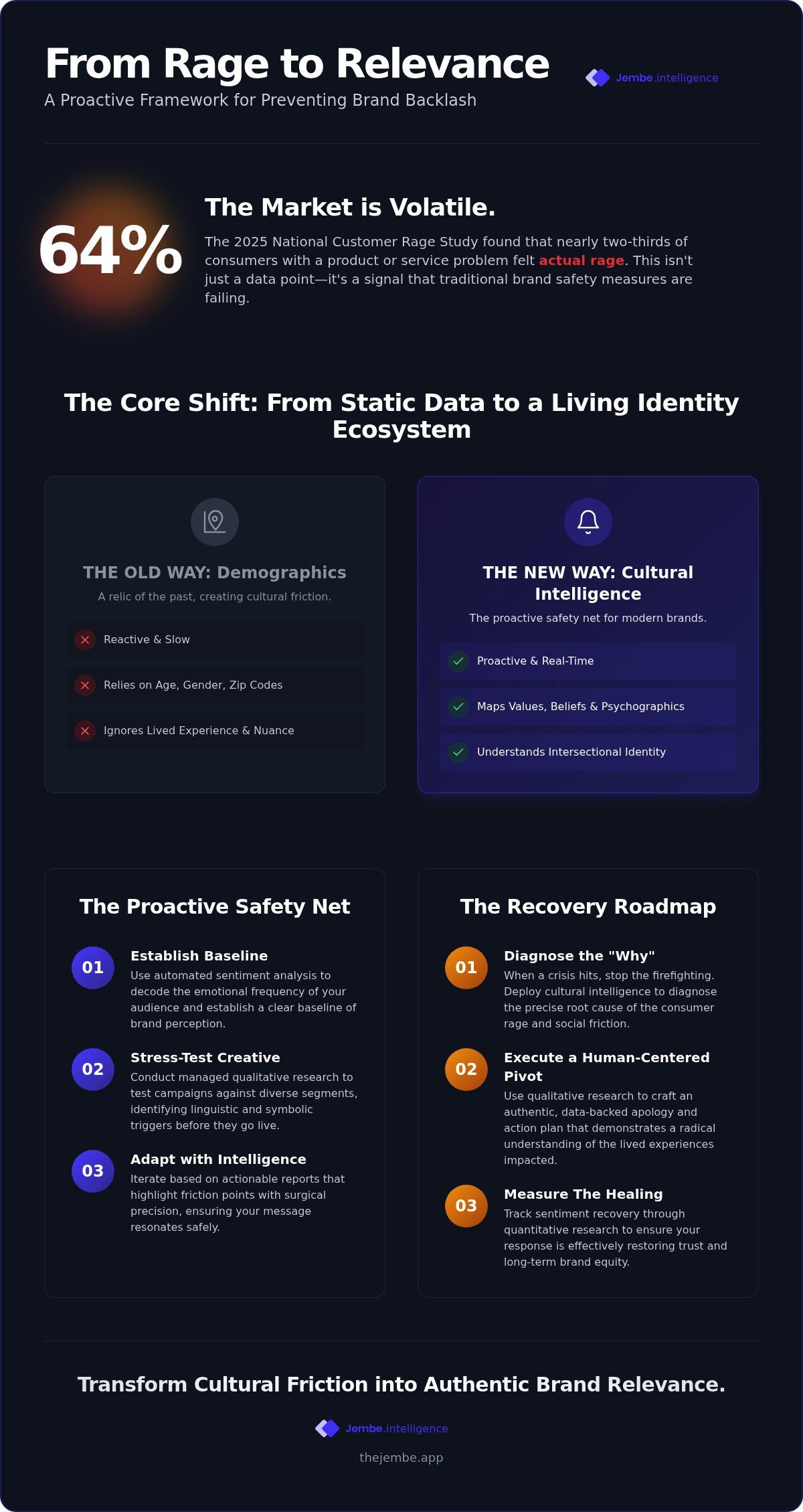
The 2025 National Customer Rage Study found that 64 percent of consumers who experienced a product or service problem felt actual rage. This isn't just a data point; it's a signal of a volatile market. You know that the distance between a viral success and a total PR collapse has never been thinner. Traditional, slow-moving research cycles simply can't keep pace with the high-velocity shifts in modern culture. Using consumer insights to prevent brand backlash is now the only way to build a resilient, proactive safety net.
This guide provides a strategic framework for identifying cultural friction points before they ignite. We'll show you how to move beyond static data silos to capture authentic, multicultural lived experiences. You'll gain a real-time pulse on consumer identity and a clear roadmap for protecting brand equity through deep, sophisticated intelligence.
Key Takeaways
- Transition from static demographics to a living identity ecosystem to pinpoint cultural friction points before they scale.
- Build a proactive strategic safety net by using consumer insights to prevent brand backlash through automated sentiment analysis and real-time monitoring.
- Close the gap between brand intent and lived experience by stress-testing creative through managed qualitative research studies.
- Master a human-centered recovery roadmap that leverages deep cultural intelligence to transform social friction into authentic brand relevance.
The Anatomy of Cultural Friction: Why Demographics Fail in 2026
Demographics are a relic. In 2026, relying on age brackets and zip codes to understand your audience is like trying to map a hurricane with a paper compass. Modern identity is a living, breathing ecosystem. It’s fluid and intersectional. When a brand ignores these layers, they create "Cultural Friction." This is the volatile gap between a brand's creative intent and the consumer’s actual lived experience. If you aren't using consumer insights to prevent brand backlash, you're essentially waiting for a spark to hit a gas leak.
This friction often accelerates into Cancel Culture, where a single cultural blind spot triggers a cascade of social rejection. Traditional social listening identifies the fire after it's already started. However, custom cultural persona development allows you to map the hidden layers of value and belief that demographics ignore. It’s the difference between seeing a customer and understanding a human. Brands that win today recognize that identity is a moving target that requires constant calibration and deep empathy.
Decoding Identity to Predict Backlash
You must capture psychographic nuances that census-level data can't reach. High-voltage cultural topics often simmer in niche communities long before they explode into mainstream discourse. By the time a trend hits a standard dashboard, the window for mitigation has closed. Proactive brands monitor these shifts in real-time to adjust their messaging, effectively using consumer insights to prevent brand backlash before friction becomes a crisis. Cultural Intelligence is the strategic operating system for 2026. This approach ensures your strategy isn't just reactive; it’s radically relevant. You can't afford to be slow when the market moves at the speed of light.
The Proactive Audit: Using Consumer Insights to Prevent Brand Backlash
Relying on "gut feeling" for brand safety is a liability. With customer complaints in the U.S. reaching a record high in the second quarter of 2026, the margin for error has evaporated. Using consumer insights to prevent brand backlash begins with deploying automated sentiment analysis to establish a crystalline baseline of your current brand perception. This isn't just about counting mentions. It's about decoding the emotional frequency of your audience in real-time.
Once you have your baseline, conduct managed qualitative research studies to stress-test campaign creative against diverse audience segments. By using consumer insights to prevent brand backlash, you identify specific linguistic or symbolic triggers that demographics might miss. Finally, iterate based on generated reports that highlight these friction points with surgical precision. This ensures your message resonates without inadvertently crossing cultural tripwires.
High-Velocity Stress-Testing for Modern Campaigns
The Jembe Platform enables you to simulate consumer reactions across multiple custom cultural personas simultaneously. This bridges the gap between high-level business strategy and the gritty reality of consumer perception. Automated reports accelerate the "Audit-Analyze-Adapt" cycle, turning months of traditional research into days of actionable intelligence. These reports don't just flag problems; they provide the deep intelligence needed to pivot with confidence. If you want to move with the speed of the market, you need a system that evolves as fast as the culture does. You can explore how to leverage these high-velocity tools to secure your brand's future.
Recovery Through Relevance: Recovering from a Brand Controversy on Social Media
Crisis isn't just noise. It's a high-velocity signal that your brand has lost its cultural frequency. When a controversy erupts, the immediate instinct is often defensive firefighting. This is a strategic error. You must stop the noise and deploy what is cultural intelligence to diagnose the root cause of the friction. Understanding the precise "why" behind consumer rage is the only way to ensure your recovery doesn't trigger a secondary wave of social rejection. Using consumer insights to prevent brand backlash in the future requires a surgical audit of the current failure.
Execute a "Human-Centered Pivot" by leveraging managed qualitative research studies. This allows you to craft an authentic, data-backed apology and action plan that actually resonates. This isn't about PR spin; it's about demonstrating a radical understanding of the lived experiences you've impacted. Once your response is live, you must measure the healing process. Track sentiment recovery through quantitative syndicated research to ensure long-term brand equity is being restored with precision and speed.
Orchestrating the Authentic Response
Avoid the "PR Template" at all costs. Consumers in 2026 spot canned responses instantly. Use real-time insights to address specific consumer pains rather than offering generic platitudes. Shift from defense to evolution. Position the controversy as a catalyst for deeper brand fluency and technological adaptation. Finally, implement continuous monitoring to prevent "backlash echoes" from contaminating future campaign cycles. Using consumer insights to prevent brand backlash becomes a permanent, living part of your strategic DNA. It’s about turning friction into momentum.
Engineering Radical Relevance
The era of reactive firefighting is over. You've seen how static demographics fail to capture the fluid complexities of 2026 identity. By mapping cultural friction points and deploying high-velocity stress tests, you transform brand safety from a defensive chore into a competitive advantage. Using consumer insights to prevent brand backlash isn't just about risk mitigation; it's about building a living system of radical relevance. You now have the framework to bridge the gap between business intent and lived experience. Precision, speed, and empathy are the pillars of modern brand equity.
The future belongs to the agile. Accelerate your strategic evolution with The Jembe Platform through real-time sentiment reporting, managed qualitative expertise, and advanced cultural persona mapping. Step ahead of the curve and lead with confidence.
Frequently Asked Questions
How can consumer insights predict a potential social media backlash?
Consumer insights identify cultural friction points before they reach a viral tipping point. By using consumer insights to prevent brand backlash, you can simulate reactions across custom cultural personas to find hidden triggers. This proactive mapping replaces guesswork with high-velocity data. It allows your team to calibrate messaging against the actual lived experiences of diverse audience segments in real-time.
What is the difference between social listening and cultural intelligence?
Social listening is a reactive tool that monitors existing conversations. Cultural intelligence is a sophisticated strategic operating system that decodes the underlying "why." While listening tracks the symptoms of a crisis, cultural intelligence uses deep persona mapping to understand the value systems driving consumer behavior. It provides the foresight needed to navigate shifting social landscapes before friction occurs.
How do you use sentiment analysis for brand crisis management?
Automated sentiment analysis reports deliver a real-time pulse on the emotional frequency of a controversy. Instead of just tracking volume, you analyze the intensity and nuance of the backlash across specific demographics. This precision allows for a surgical response. You can identify exactly where your brand equity is leaking and pivot your strategy to address the most volatile friction points.
Can qualitative research help a brand recover after a controversy?
Managed qualitative research studies are critical for crafting an authentic recovery roadmap. They provide the deep intelligence required to move beyond generic PR templates. By engaging directly with the lived experiences of impacted communities, you can develop a data-backed action plan. This human-centered approach ensures your apology is relevant and demonstrates a genuine commitment to evolving your brand fluency.
Want this kind of intelligence wired into your team's workflow? Get started with Jembe.Intelligence →