Consumer Empathy Mapping: A Strategic Blueprint for Cultural Fluency in 2026
Traditional demographics are liabilities. They give you a silhouette when you need a soul. By the time a census report is published, the cultural pulse has already moved.
Jembe.Intelligence
June 20, 2026
Your static consumer personas aren't just outdated; they are liabilities in a market that moves at the speed of a social algorithm. You've likely felt the sting of a campaign that looked perfect on paper but felt like a caricature in practice. It's a common struggle. Traditional data often fails to capture the nuance of 2026's values-driven, AI-integrated landscape. When 76% of your customers expect deep personalization, guessing isn't a strategy; it's a risk.
This article provides the high-velocity framework you need to master consumer empathy mapping. We'll show you how to decode modern consumer identity and transform raw data into radical brand relevance. It's time to stop reacting to trends and start anticipating them. We will explore how to build a living system for rapid cultural adaptation, ensuring your insights drive measurable ROI and strategic alignment across your entire organization. Get ready to move beyond static snapshots and embrace a more agile, technologically-driven approach to human understanding. The future of brand relevance isn't about looking back at what happened; it's about feeling the pulse of what's next.
Key Takeaways
- Transform consumer empathy mapping from a basic design exercise into a high-velocity strategic blueprint for navigating fluid 2026 identities.
- Move beyond static demographics by learning to capture the authentic voice and internal belief systems of your target audience in real-time.
- Implement a 5-step process that utilizes data-driven personas and syndicated research to ensure your brand remains culturally fluent.
- Bridge the gap between raw data and radical relevance by re-imagining the traditional empathy quadrants for today's complex social landscape.
- Scale your insights by evolving from one-off visualizations to a continuous, living system of consumer intelligence powered by The Jembe.
What is Consumer Empathy Mapping? Beyond the Design Thinking Basics
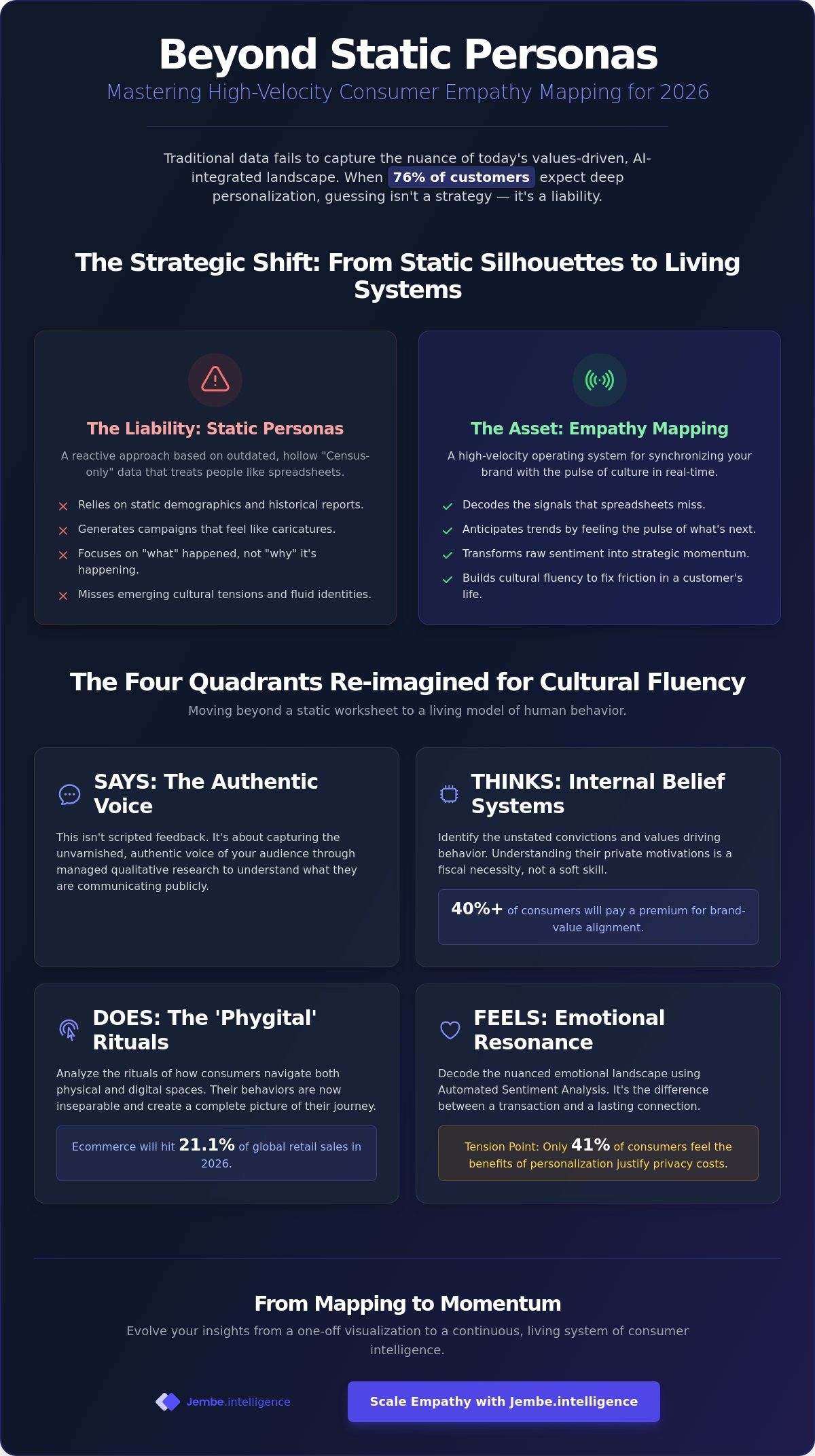
Stop looking at spreadsheets. Start looking at lives. An Empathy map is often dismissed as a basic design tool. That’s a mistake. In the high-velocity market of 2026, consumer empathy mapping is a strategic operating system. It’s a collaborative visualization of your target audience’s lived experience, moving beyond the hollow "Census-only" segments that treat people like static data points. Modern consumers have fluid identities. They don't fit into neat boxes. They are walking contradictions, balancing economic pressure with values-driven purchases. In a fragmented market, empathy isn't a soft skill. It's your highest-velocity asset.
Traditional demographics are liabilities. They give you a silhouette when you need a soul. By the time a census report is published, the cultural pulse has already moved. Empathy mapping allows your team to synchronize with the current moment, decoding the signals that spreadsheets miss. It’s about radical brand relevance. If you aren't decoding the "why" behind the "what," you're just guessing at scale. You need to understand the heartbeat, not just the click-through rate.
The Strategic Shift: From User to Culture
Legacy brands focus on "user experience" in a vacuum. Visionary brands focus on cultural intelligence. While UX empathy fixes a friction point in an app, cultural empathy fixes a friction point in a life. Consumer empathy mapping reveals the deep-seated "unmet needs" that quantitative data often obscures. It’s the difference between knowing a customer bought a product and knowing they bought it to feel a sense of belonging in a shifting social landscape. Data tells you the volume of a trend. Empathy tells you its velocity and direction.
This process exposes the internal belief systems and cultural values driving behavior. You gain the ability to:
- Identify emerging cultural tensions before they go mainstream.
- Align brand messaging with the authentic lived experience of diverse audiences.
- Transform raw sentiment into actionable strategic momentum.
The goal isn't just to understand your customer. It's to become fluent in their world. When you master this framework, you stop chasing the pulse and start setting the pace. It's about moving from a static observer to a dynamic participant in the consumer's journey.
The Four Quadrants Re-Imagined for Cultural Fluency
The traditional four-quadrant model is a relic of slower times. To make consumer empathy mapping work in 2026, you must re-imagine these categories as dynamic data streams rather than static boxes. While a standard Empathy Mapping guide provides the skeleton, your strategy needs the muscle of real-time cultural context to survive. It's not about filling out a worksheet; it's about building a living model of human behavior.
- Says: This isn't about scripted feedback or focus group politeness. It’s about capturing the unvarnished, authentic voice of your audience through managed qualitative research.
- Thinks: Identify the internal belief systems. With over 40% of consumers willing to pay a premium for brand-value alignment, understanding their private convictions is a fiscal necessity.
- Does: Analyze the rituals. How do they navigate "phygital" spaces? Since ecommerce is expected to hit 21.1% of global retail sales in 2026, their physical and digital behaviors are now inseparable.
- Feels: Decode the emotional resonance. It’s the difference between a transaction and a connection.
Decoding the "Feels" with Automated Sentiment
Emotions are messy. AI makes them actionable. Utilizing automated sentiment analysis provides the raw fuel for high-fidelity maps. We’ve moved beyond binary "happy or sad" metrics. You need to map nuanced emotional landscapes, like the tension between a desire for personalization and the fact that only 41% of consumers believe the benefits justify the privacy costs. This granular data allows you to pivot before the sentiment sours. It’s about precision, not just perception.
The Cultural Context Layer
Quadrants don't exist in a vacuum. You must view every insight through the lens of what is cultural intelligence. By identifying "cultural friction", where a consumer's values clash with market reality, you find your next innovation opportunity. If you're ready to stop guessing and start scaling these insights across your organization, exploring the Jembe Platform is the logical next step for your strategy team. Empathy is the engine, but culture is the map.
The High-Velocity Empathy Mapping Template: A 5-Step Process
Velocity is non-negotiable. If your mapping process takes weeks, the culture has already shifted, leaving your strategy stuck in the past. You need a streamlined, 5-step blueprint that integrates high-tech insights with human intuition. This is how you transform consumer empathy mapping from a static exercise into a strategic engine.
- Step 1: Define the Persona Focus. Use data-driven persona examples to narrow your scope. Stop targeting "everyone." Focus on the specific cultural segments that drive your growth.
- Step 2: Aggregate Real-Time Insights. Pull from quantitative syndicated research and qualitative studies. With 64% of shoppers using AI tools for product research, your data must be fresh.
- Step 3: Map the Lived Experience. Populate your quadrants. Focus on cultural tension points. For instance, map the friction between the 57% of consumers seeking deals and their desire for values-aligned products.
- Step 4: Synthesize Needs and Insights. Identify "unspoken truths." This is where you find radical relevance. It’s the "aha" moment where behavior meets belief.
- Step 5: Execute and Evolve. Turn the map into a strategic brief for immediate action. A map that doesn't drive a campaign is just wallpaper.
The Jembe.intelligence Template: Built for Momentum
High-energy mapping sessions are the antidote to groupthink. Bring your cross-functional teams together for rapid-fire visualization. Effective Persona Empathy Mapping requires diverse perspectives, not just marketing echo chambers. Use generated reports from Jembe.intelligence to validate your findings instantly. This ensures your strategy is bulletproof before it hits the market. You don't have time for slow cycles. You need to validate, iterate, and launch.
Ready to turn these insights into a competitive advantage? Start your subscription to the Jembe.intelligence platform today and build your first high-velocity map.
From Mapping to Momentum: Scaling Empathy with Jembe.intelligence
A static map is a liability. It’s a snapshot of a moment that has already passed; it captures a consumer who has already moved on. To maintain radical relevance in 2026, your consumer empathy mapping must evolve into a living, breathing system. The market doesn't wait for your annual strategy review. It demands continuous intelligence. If your insights aren't moving at the speed of culture, you aren't leading. You're lagging.
Jembe.intelligence provides the high-tech infrastructure needed for this strategic evolution. We remove the friction of data collection through Managed Qualitative Research Studies. This allows your team to focus on execution rather than logistics. This isn't just about having a digital whiteboard. It’s about leveraging a sophisticated system that uncovers the hidden layers of human interaction in real-time. We provide the clarity you need to navigate shifting social landscapes with total confidence.
Integrating Empathy into Your Strategic Operating System
Empathy maps shouldn't sit in a digital folder. They must fuel more accurate custom cultural persona development. When your personas are rooted in real-time empathy, they stop being caricatures. They start being strategic assets. This integration ensures that every department stays aligned with the consumer's actual lived experience. It's about building a brand that feels human at scale.
The Power of Real-Time Analysis and Reporting
Precision requires persistent observation. Our sophisticated analysis and reporting services ensure you maintain cultural fluency as the market shifts. By transforming raw sentiment into generated reports, you align your entire organization with the cultural pulse instantly. This isn't just about understanding your audience. It’s about scaling that understanding to drive measurable ROI. You gain the ability to pivot before your competitors even see the trend coming.
Stop guessing. Start decoding. The era of slow, static insights is over. Embrace a more agile, technologically-driven approach to human understanding with a Jembe.intelligence subscription. It’s time to transform your raw data into radical brand relevance and claim your place at the forefront of 2026’s cultural landscape.
Seize the Strategic Advantage
The era of guessing is over. You've seen how consumer empathy mapping transforms from a simple design exercise into a high-velocity strategic blueprint. By re-imagining the quadrants and adopting a 5-step process built for speed, you move beyond static caricatures. You begin to see the lived experience of your audience with crystalline clarity. This isn't just about understanding; it's about out-evolving the competition in a market where cultural pulse is the only currency that matters. You're no longer just a spectator of trends.
Precision requires the right infrastructure. You need a system that breathes with the market. Whether it's through automated sentiment analysis for real-time decoding or managed qualitative research studies for deep human insight, the tools you choose define your trajectory. Our visionary cultural intelligence reports ensure you don't just react to change; you lead it. It's time to stop looking at what was and start building what will be. The complexity of 2026 demands a guide that's as agile as the consumers you serve.
Accelerate your brand’s evolution with Jembe.intelligence. The future belongs to those who can decode it in real-time. You have the framework. Now, take the momentum. Let's build something radical together.
Frequently Asked Questions
What is the primary goal of consumer empathy mapping?
The primary goal is to establish deep, actionable alignment between a brand's strategy and the lived experiences of its target audience. It moves beyond superficial data to decode the internal belief systems and cultural values that drive purchasing decisions. By visualizing what a consumer says, thinks, does, and feels, organizations can transform raw data into radical brand relevance and navigate complex social landscapes with precision.
How is empathy mapping different from a customer persona?
While a customer persona provides a static silhouette of a demographic segment, consumer empathy mapping offers a dynamic, multi-dimensional view of their internal world. Personas often rely on historical data and rigid categories. In contrast, empathy mapping focuses on the immediate emotional and cultural context. It’s the difference between knowing who someone is on paper and understanding why they act in a high-velocity, shifting market.
Can empathy mapping be used for B2B marketing strategies?
Empathy mapping is essential for B2B strategies because business decisions are still made by humans with specific cultural identities and professional anxieties. In B2B contexts, the quadrants focus on the professional rituals, organizational pressures, and internal belief systems of decision-makers. Mapping these layers allows brands to address unmet needs in the corporate journey that generic marketing often misses, driving deeper loyalty and higher conversion rates in complex sales cycles.
How often should a brand update its consumer empathy maps?
Brands should treat empathy maps as living systems rather than static documents, updating them whenever a significant cultural or market shift occurs. In the high-velocity environment of 2026, waiting for an annual review is a liability. Real-time updates are necessary to capture the fluid identities of modern consumers. Integrating automated sentiment analysis allows for continuous iteration, ensuring your strategic blueprint remains synchronized with the current cultural pulse and economic reality.
Do I need qualitative research to create an accurate empathy map?
Qualitative research is the bedrock of an accurate map because it provides the authentic voice and nuanced sentiment that quantitative data often obscures. While numbers show the volume of a trend, managed qualitative research studies reveal the underlying motivation. Without this deep human insight, your map risks becoming a collection of assumptions. Combining real-time qualitative data with automated reporting ensures your strategy is grounded in the actual lived experience of your audience.
Want this kind of intelligence wired into your team's workflow? Get started with Jembe.Intelligence →