Top Market Research Tools for 2026: Beyond Data to Cultural Intelligence
Knowing what someone buys is merely a transaction record. Understanding why they identify with a specific social movement or subculture is a strategy.
Jembe.Intelligence
June 20, 2026

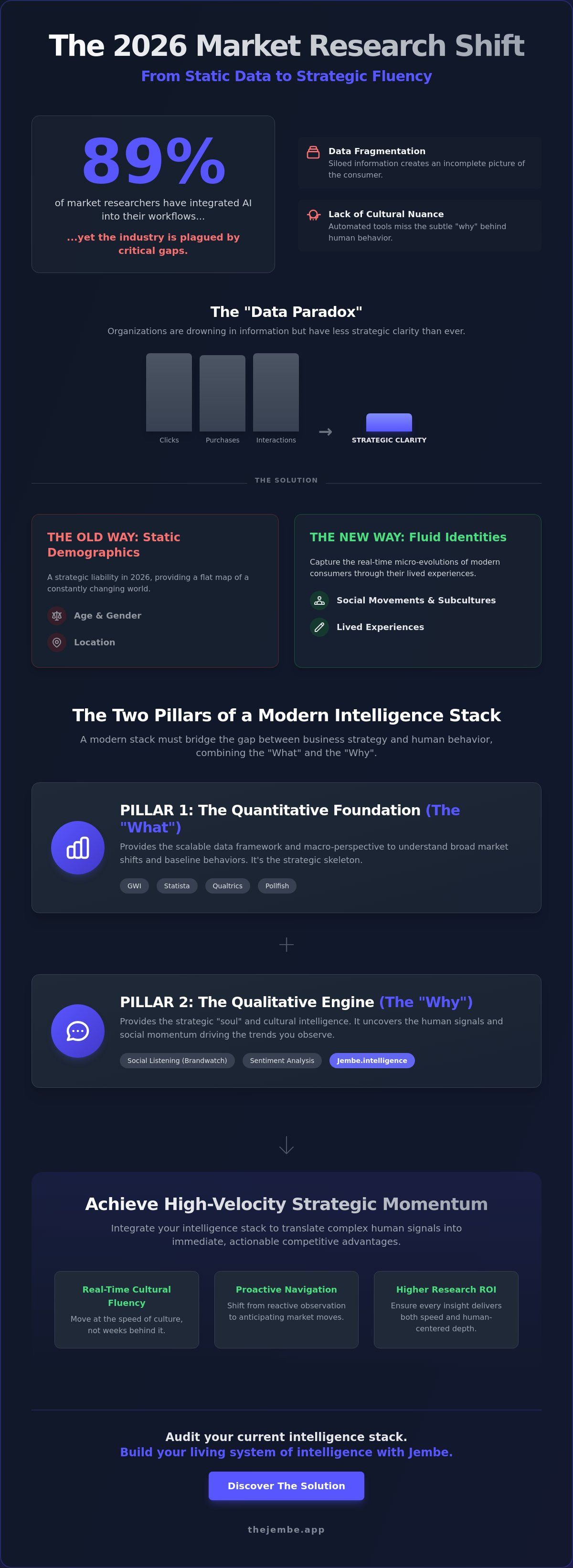
89% of market researchers have integrated AI into their daily workflows, yet the industry remains plagued by data fragmentation and a glaring lack of cultural nuance. You've likely felt the friction of automated tools that miss the subtle shifts in human behavior or the agonizingly slow turnaround times of traditional qualitative research. Static data is no longer a competitive advantage. In an environment defined by rapid social evolution, identifying the top market research tools is no longer about simple data collection; it's about building a living system of intelligence.
We understand that the old ways of fragmented, slow-moving insights are failing the modern decision-maker. You'll discover the elite platforms required to decode modern consumer identity and accelerate your strategic evolution in 2026. This guide explores how to consolidate your intelligence to achieve real-time cultural fluency and a higher ROI on your research spend. We'll break down the sophisticated technology that moves your brand from reactive observation to proactive, high-speed navigation of the social landscape. The future belongs to those who can translate complex human signals into precise strategic momentum.
Key Takeaways
- Move beyond static demographics to capture the fluid identities of 2026 through the lens of lived experience data.
- Evaluate the top market research tools to solve the "Data Paradox" of high information volume and low strategic clarity.
- Integrate tech-enabled, managed qualitative research to provide the strategic "soul" and "why" behind quantitative frameworks.
- Utilize Jembe.intelligence to automate sentiment analysis and generate the cultural reports necessary for real-time strategic evolution.
- Audit your current intelligence stack to ensure it delivers both high-velocity speed and human-centered depth across all departments.
The 2026 Shift: Why Legacy Market Research Tools Are Failing Modern Brands
Static demographics are effectively dead. In 2026, relying on age, gender, or location to predict consumer behavior is a strategic liability. Modern consumers define themselves through lived experiences and fluid identities that shift across digital and physical spaces. Traditional market research methods often fail to capture these micro-evolutions because they were built for a more predictable, monolithic world.
We're witnessing the "Data Paradox." Organizations are drowning in information. They track every click, every hover, and every purchase. Yet, despite this mountain of data, they've never had less clarity on how to actually move the needle. This happens because many legacy top market research tools focus exclusively on the "what" while completely ignoring the "why." They provide a flat map of a territory that is constantly changing its topography.
A modern research stack must do more than count responses; it must bridge the gap between business strategy and human behavior. For online brands, this bridge is often built through eCommerce AI transformation services that turn cultural insights into operational reality. Cultural Intelligence is the high-velocity strategic operating system for 2026. It's the difference between seeing a trend and understanding the social momentum driving it.
From Data Collection to Strategic Fluency
Knowing what someone buys is merely a transaction record. Understanding why they identify with a specific social movement or subculture is a strategy. As the global market research services industry is projected to reach $96.77 billion in 2026, the winners won't be the brands with the most data points. They'll be the ones with the most fluency in human signals. For high-growth firms, this fluency is a critical asset when seeking capital; learn more about how investor relations platforms highlight these competitive edges. Speed is the new currency. If your insights take weeks to process, the culture has already moved on.
Navigating these shifts requires a specialized cultural intelligence platform that interprets signals in real-time. This isn't about looking in the rearview mirror. It's about building a system that evolves as fast as the environment it tracks. You need to move beyond simple collection toward an integrated intelligence stack that powers every strategic move. The goal is a living, breathing system that translates complex human interaction into immediate, actionable competitive advantages.
The Quantitative Foundation: Top Tools for Scalable Consumer Data
Scalable data is the framework. It's the structural support for every strategic move. Without it, you're guessing. With it, you're building on solid ground. In 2026, the top market research tools for quantitative scale are those that prioritize velocity without sacrificing accuracy. Platforms like GWI and Statista remain essential for category-level dominance. They provide the macro-perspective needed to understand broad market shifts and baseline behaviors. These tools allow you to zoom out and see the entire field before you make a play.
Effectiveness requires more than just raw numbers. It demands market research and competitive analysis that identifies gaps before the competition sees them. By integrating quantitative syndicated research, brands can engineer market dominance through pre-validated data streams. This isn't just about collecting facts; it's about building a strategic skeleton. But remember: a skeleton without a soul is just a relic. Quantitative data tells you what is happening, but it rarely explains why.
Survey technology has transformed into a high-speed feedback loop. Static surveys are relics. High-speed feedback is the new standard. Tools like Qualtrics and Pollfish are now leveraging AI to eliminate the lag between question and insight. These systems don't just gather responses; they analyze intent and filter noise in real-time. This allows for rapid iteration. You can pivot your messaging in hours, not months. The speed of the market demands a stack that never sleeps.
Real-Time Sentiment and Trend Tracking
Understanding the pulse of the market requires an "always-on" approach. Social listening has moved from a vanity metric to a core strategic pillar. For 2026, the battle for social intelligence is led by Brandwatch and BrandMentions. Brandwatch offers enterprise-level depth and predictive analytics, while BrandMentions excels in agility and immediate alert systems. Both are vital for maintaining a fresh, alert presence in shifting social landscapes; you might also explore ChatGPT mention tracking to monitor how your brand is represented within generative AI platforms.
The real power lies in automated sentiment analysis. It decodes the emotional current behind the data. It tells you if a spike in mentions is a wave of support or a brewing crisis. To truly master this landscape, you need a system that synthesizes these signals into a coherent narrative. Explore how a comprehensive intelligence platform can turn these fragmented data points into a unified strategic advantage.
The Insight Engine: Top Platforms for Qualitative Depth and Cultural Intelligence
Raw data is a commodity. True insight is a weapon. While previous sections established the quantitative framework, the top market research tools for 2026 are those that facilitate deep, qualitative resonance. DIY platforms often promise speed but deliver shallow results. This is the catalyst for the return to Managed Qualitative Research Studies. Enterprise brands need more than a dashboard; they need a strategic partner that understands the nuance of human behavior and the hidden layers of social interaction.
This managed approach serves as a force multiplier. It allows internal teams to transcend the friction of data collection and focus on high-level execution. A Jembe.intelligence subscription offers a sophisticated alternative to fragmented systems. It delivers automated sentiment analysis and generated cultural reports that move at the speed of social change. This isn't just research; it's a strategic evolution designed to keep your brand ahead of the curve.
We're witnessing the end of the Census-based persona. In its place, Custom Cultural Persona Development offers a window into the fluid identities of 2026. These aren't static profiles; they are dynamic representations of lived experience. By focusing on how people actually inhabit their world, you gain a level of precision that traditional demographics simply cannot match. It’s about building a living system of intelligence.
Capturing the Lived Experience
Video is the new text. Digital diary studies and video interview analysis have become the primary vehicles for capturing the cultural pulse. For researchers seeking deeper biological insights, MindRove provides high-performance neural interfaces that capture physiological signals directly for consumer R&D. You can also explore Prophea.X to synchronize these behavioral data streams for more precise analysis. Complementing these high-tech tools, Jembe.intelligence uses managed qualitative studies to extract human-centered data from the noise, focusing on the "why" behind every interaction. This ensures your brand remains alert, fresh, and intellectually sharp in a shifting landscape. You don't just see the trend; you understand the momentum driving it.
Unlock cultural intelligence with Jembe.intelligence and lead your category with precision.
Forging Your Intelligence Stack: A Framework for Strategic Selection
Selection is a strategic act. It determines your brand’s reaction time in a world that never pauses. You must audit your current data gaps immediately. Are you capturing the "what" but completely missing the "why"? Most organizations are heavy on quantitative volume but starved for human resonance. Identifying the top market research tools for your specific ecosystem requires a move away from cost-centric thinking toward strategic velocity. You need a system that doesn't just store data but breathes with the market.
Prioritize platforms that offer both automated speed and human-centered depth. The goal is to eliminate the friction between raw signal and strategic execution. To ensure these strategic projects are managed with expert precision, you can explore PMP® Certification Training and master the frameworks required for high-impact results. Intelligence is useless if it's trapped. Insights must move from the research lab to the C-suite with zero lag, ensuring that every decision is backed by real-time cultural fluency. A Jembe.intelligence subscription accelerates strategic evolution by synthesizing complex social signals into immediate, high-impact intelligence that powers every level of your organization.
Implementation: From Reporting to Action
Strategic momentum depends on how quickly you turn a report into a move. Static PDFs are where insights go to die. In 2026, generated reports must serve as the fuel for immediate brand shifts. They should provide the clarity needed to pivot messaging or product strategy in hours, not weeks. Your intelligence stack is your competitive edge; if it isn't driving action, it's just overhead. Efficiency is the baseline, but fluency is the goal—an objective shared by operational sectors where tools like GoBuid are used to digitize site documentation and ensure seamless project execution.
The 2026 Intelligence Checklist
To dominate your category, your research framework must meet three non-negotiable criteria:
- Multi-methodology Integration: Seamlessly blending quantitative scale with qualitative depth to see the full picture.
- Real-time Tracking: Eliminating the insight lag to capture sentiment as it happens, not after it has passed.
- Cultural Fluency: Decoding identity and lived experience beyond the limitations of traditional demographics.
Move beyond conventional, slow-moving thinking. Embrace an agile, technologically-driven approach to understanding your environment. The future belongs to the brands that can navigate complex social landscapes with precision and speed. Your stack is the map; make sure it's high-definition.
Master the Cultural Pulse
The window for reactive decision-making is closing. In 2026, the distinction between market leaders and also-rans will be defined by their ability to navigate human complexity with technological precision. You've seen that the top market research tools of this era must transcend the limitations of static data. They must offer a living, breathing system of intelligence that bridges the gap between raw numbers and cultural fluency. The era of the flat demographic is over; the era of lived experience has arrived.
Strategic evolution requires a stack that balances high-velocity quantitative scale with the deep resonance uncovered through expert-led managed qualitative research. It's time to move beyond the data paradox and embrace a model where insights move at the speed of social change. You are now equipped with the framework to audit your gaps and forge an intelligence engine that delivers higher ROI and real-time clarity. The future isn't something that happens to your brand; it's something you navigate with intent.
Accelerate your strategic evolution with The Jembe Platform. Our visionary cultural intelligence platform combines real-time automated sentiment analysis with managed qualitative depth to ensure your brand maintains constant momentum. Don't just watch the market. Lead it with absolute confidence.
Frequently Asked Questions
What are the best market research tools for small businesses versus enterprises in 2026?
Small businesses should prioritize high-velocity, accessible platforms like Pollfish or Semrush for immediate visibility and agile feedback. Enterprises require sophisticated, integrated systems like Qualtrics or Brandwatch to manage complex global datasets across multiple departments. The top market research tools for any organization are those that bridge the gap between raw data and strategic action. While SMBs prioritize agility, enterprises must invest in platforms that offer deep structural analysis and cross-functional accessibility.
How does automated sentiment analysis differ from traditional social listening?
Automated sentiment analysis decodes the emotional "why" behind the conversation, whereas traditional social listening often stops at "what" is being said. Social listening tracks volume and keywords; sentiment analysis interprets the cultural pulse and intent in real-time. This distinction is vital for navigating modern social landscapes where context is everything. By moving beyond simple word counts, brands gain a high-tech guide for understanding shifting consumer identities and avoiding strategic blind spots.
Can I replace my qualitative research team with AI-driven tools?
You shouldn't replace human expertise, but you must augment it with AI to maintain momentum. AI-driven tools act as force multipliers that handle high-velocity data processing and initial pattern recognition. However, human researchers provide the sophisticated strategic interpretation required for complex cultural movements. The most successful organizations use a hybrid approach, leveraging managed qualitative research studies to combine technological speed with the nuanced perception only humans can offer.
What is the most cost-effective way to develop custom cultural personas?
Utilizing a subscription-based intelligence platform is the most efficient method for developing custom cultural personas. These systems automate the synthesis of behavioral data and sentiment, allowing you to move beyond static Census categories without the high overhead of traditional, manual persona development. This approach provides a living system that evolves as your audience does. It ensures your strategic evolution stays ahead of the curve while maximizing the ROI of your research spend.
How often should a brand update its syndicated research data?
Brands must move toward a continuous, "always-on" feedback loop rather than relying on annual updates. In the dynamic environment of 2026, quarterly refreshes of top market research tools and syndicated data are the bare minimum for survival. High-speed categories may require monthly or even real-time updates to capture emerging trends. Static data is a relic; constant adaptation is the only way to maintain cultural fluency and strategic relevance in a shifting world.
Want this kind of intelligence wired into your team's workflow? Get started with Jembe.Intelligence →